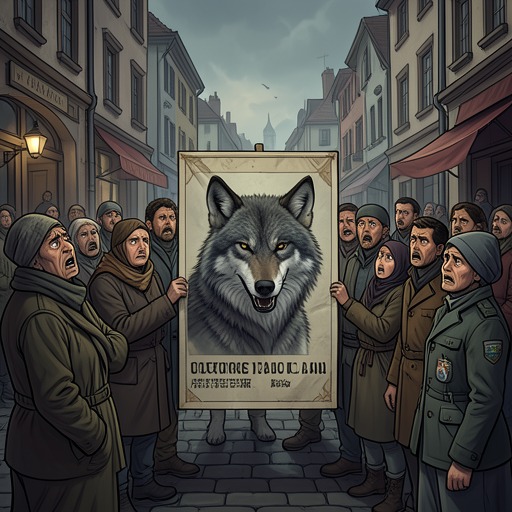
Churchill wolf panic of 1946
Never Cry WolfChurchill wolf panic of 1946 was a brief episode of armed alarm during a season of hunger and rabies, but its afterlife outlasted the emergency. A report by a returning Canadian Army corporal prompted a large-scale search for wolves; the search produced casualties among people and dogs, while a supposed wolf sighting proved to be a cocker spaniel. When a genuinely sick wolf was finally found, it was too weak to move. The contrast between that animal and the later stories of an invasion makes the episode an example of how fear could turn a limited encounter into a durable public memory.
Hunger and the Disease
The panic unfolded against ecological hardship rather than an unexplained surge of healthy, aggressive wolves. In 1946, lemmings in the Canadian Arctic were at the low point in their four-year cycle. At the same time, depleted caribou herds altered their established migration and mostly bypassed southern central Keewatin. The resulting shortage affected people as well as wildlife: the book describes hunger weighing on the land and identifies the season as disastrous for Eskimos, foxes, and wolves.
Rabies spread among starving foxes and began to affect wolves. The account emphasizes that rabies does not make an animal simply “mad”: it disrupts the nervous system, leaving affected animals erratic and less governed by fear. Sick wolves might wander into places where people and domestic animals lived, creating frightening encounters without demonstrating that wolves generally posed the threat people imagined. In the book’s explanation, hunger and disease supply the concrete conditions behind the Churchill episode; the panic, by contrast, grew around an account of danger that could not be physically substantiated.
Report and Armed Search
The alarm began when a Canadian Army corporal encountered a wolf while making his way back to barracks after visiting the Churchill beer hall. By his account, an enormous wolf leaped at him with murderous intent, and he escaped by running about a mile to the guardhouse. He could show no physical evidence of what had happened, though the narrator notes that the experience had evidently left him deeply shaken. His warning was enough to send the Army camp into near-hysterical panic.
American and Canadian contingents were mobilized. Armed squads searched the surrounding country with rifles, carbines, and spotlights, intent on dealing with a menace that, within hours, had expanded in the telling into several packs of starving wolves. The response thus moved quickly from one person’s report to an organized hunt. Its scale was out of proportion to what had been verified: the corporal’s account had no physical corroboration, yet a forceful public response followed before the supposed packs had been established.
Confusion, Casualties, and the Actual Wolf
The search itself caused casualties. Eleven Husky dogs, an American private first class, and a Chippewayan Indian returning home late became victims of the vigilantes rather than of a wolf. For two days, children and women remained indoors. Foot soldiers nearly disappeared from the camp, while men traveling to distant buildings either went in armed jeeps or did not go at all. These details show that the panic changed daily routines across the community, not merely the conduct of the soldiers sent to search.
On the second day, a light Army aircraft taking part in the hunt spotted what was believed to be a wolf. A detachment of Mounted Police went out to deal with it, only to find that the animal was a cocker spaniel belonging to the Hudson’s Bay Company manager. The mistaken identification sharply exposed the gap between expectation and observation: even an aerial sighting, followed by an armed response, did not confirm the feared wolf threat.
The panic began to ease on the third day. Late that afternoon, a six-ton Army truck returning from the airport came upon a bundle of fur in the road. The driver braked but could not stop in time. The animal was a wolf, so ill that it could no longer move, and the collision killed it. This late encounter supplied evidence of a real sick wolf, but not of the invading packs that had shaped the search. The distinction is central to the episode: a wolf was present, while the scale and character of the menace attributed to wolves had not been borne out.
The Panic’s Afterlife
The book’s account does not end with the emergency. Residents of Churchill and soldiers scattered across the continent continued, years later, to recount an invasion of wolves. In those recollections, people described desperate personal encounters, women and children attacked, dog teams destroyed, and a whole community living under siege. The stories accumulated details and collective certainty beyond what the episode’s documented course established.
The narrator underscores that inflation by extending the remembered invasion to an extravagant imagined climax: people fleeing across frozen country in a sleigh, pursued by a wave of wolves. The image is not presented as an event that occurred, but as the missing flourish in the legend. Against it stand the more limited circumstances of the episode: a corporal’s uncorroborated report, a mistaken sighting of a dog, casualties caused by the searchers, and a single gravely ill wolf encountered on the road. By setting these facts against the scale of the remembered danger, the account shows how panic and repetition sustained the wolf’s reputation long after the immediate alarm had passed.